
For most of software engineering’s history, the hierarchy was defined by coding ability. The best developers wrote the most elegant, efficient, correct code. Seniority correlated with depth of technical knowledge — the ability to solve harder problems with better solutions.
That definition is changing. In 2026, the most valuable software engineers are not necessarily those who write the best code. They are the ones who know how to direct, evaluate, and orchestrate systems that generate code autonomously.
Ninety per cent of engineers are already integrating AI into their workflows, with the primary function shifting from production of code to orchestration and oversight of AI-generated output. The developer hierarchy of 2026 is being defined by a new dimension: the ability to work effectively at the human-AI interface.
The Rise of the Supervisor Class
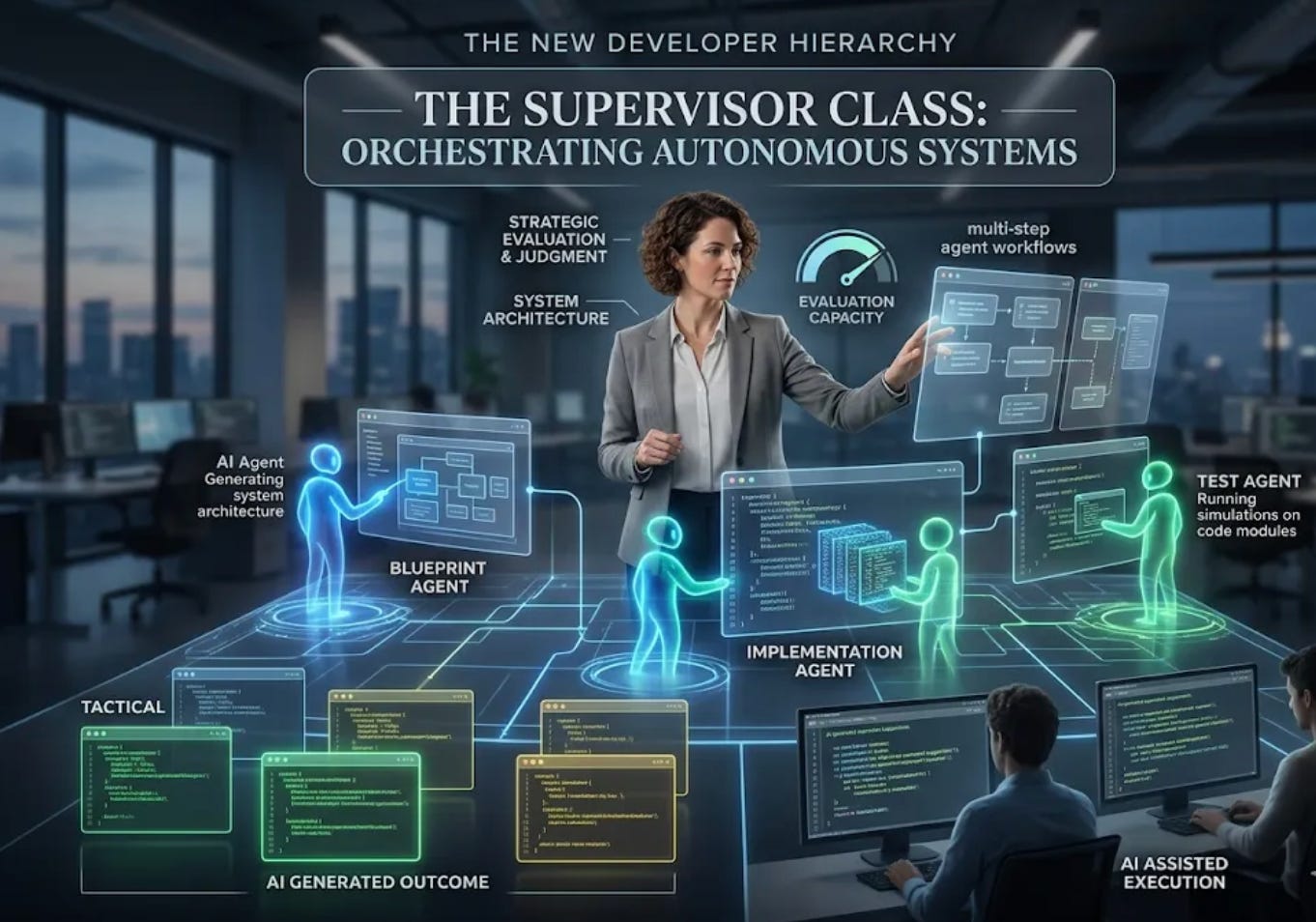
The term “Supervisor Class” has entered the language of technology leadership to describe a growing category of developers whose primary value is not manual code production but high-level orchestration of autonomous systems.
These are engineers who architect entire delivery pipelines — defining what AI agents build, reviewing their outputs, integrating the results, and ensuring that what ships is correct, secure, and fit for purpose. Their expertise is in judgment: knowing when to trust AI output, when to reject it, and when to intervene.
Fifty-seven per cent of organisations now deploy multi-step agent workflows in production. In these environments, an individual developer might be coordinating an architecture agent, an implementation agent, a test agent, and a code review agent — each handling different components of the delivery pipeline.
The New Developer Hierarchy in Practice
The developer market in 2026 is bifurcating along a clear axis.
At the strategic end, developers who can architect systems, orchestrate AI agents, evaluate complex outputs, and make high-stakes technical decisions are commanding significant salary premiums. At the tactical end, developers whose primary function is executing well-defined instructions are facing structural wage pressure. These are the tasks that AI coding assistants handle most reliably.
What AI Can and Cannot Be Delegated
Despite the scale of the shift, the actual scope of what developers can delegate to AI is more constrained than the headline figures suggest.
Current research indicates that developers can only fully delegate 0 to 20 per cent of tasks to AI. For the remaining 80 per cent or more, developers are integrating AI as a tool or reference but remain actively responsible for the output.
This matters because it defines what orchestration actually involves. Directing AI agents is not the same as handing off responsibility. The developer skill being rewarded is not the ability to prompt effectively, but the ability to evaluate correctly.
Where Strategic Developers Command Premium Value
AI system design and architecture. Building systems that incorporate AI agents reliably — handling failure modes, managing context, ensuring safety and correctness properties.
Security and verification. Reviewing AI-generated code for security vulnerabilities and designing the oversight structures that protect AI-integrated systems from failure.
Product-aligned engineering leadership. Senior engineers who can translate business and product requirements into the architectural decisions that constrain and direct AI-assisted delivery.
How to Position Yourself in the New Hierarchy
Invest in architectural depth. Understand systems at a level that allows you to evaluate what AI produces in its full context. The ability to assess whether AI-generated architecture decisions are sound is not widely distributed.
Develop evaluation skills. The most valuable developer in an AI-augmented team is not the fastest prompter — it is the person whose quality bar is highest.
Invest in communication. The ability to translate between business requirements and precise technical instructions becomes more valuable as the purely technical work is increasingly handled by AI.
Build experience with agentic systems. Working directly with multi-agent frameworks, understanding how they fail, and developing the judgment to direct them effectively is the frontier competency for 2026 and beyond.
Conclusion
The developer hierarchy is not disappearing — it is being redrawn. The skills that define the most valuable engineers in 2026 are not fundamentally different from those that always defined great engineering: deep judgment, strong architecture, and the ability to evaluate quality critically. What has changed is the medium.
This is an opportunity, not a threat. But only for the developers who choose to develop toward it.
FAQs
Q: What is the “Supervisor Class” of developers?
Developers whose primary value is orchestrating and overseeing AI-generated code rather than writing it manually. They architect delivery pipelines, direct AI agents, evaluate outputs, and hold accountability for what ships.
Q: How is the developer hierarchy changing in 2026?
It is bifurcating between strategic developers who orchestrate AI systems and command significant salary premiums, and tactical developers executing well-defined tasks — where AI tools are increasingly able to compete.
Q: How much of a developer’s work can actually be delegated to AI?
Current research suggests only 0–20% can be fully delegated. The remaining 80%+ requires active human supervision — meaning the core developer skill being rewarded is the capacity to evaluate AI output correctly.
Q: What skills matter most for developers navigating this shift?
Architectural depth, evaluation and quality judgment, communication fluency between technical and business stakeholders, and direct experience with agentic systems and multi-agent frameworks.
Q: Are tactical coding roles disappearing?
Not immediately — but they are under structural wage pressure. Developers who build only at this level without developing higher-order skills face an increasingly competitive market.
Q: What is “agentic coding” and why does it matter for developers?
Agentic coding refers to workflows where AI agents autonomously handle portions of the software development lifecycle. 57% of organisations now run multi-step agent workflows in production.
Q: How should developers prepare for the AI orchestration era?
Invest in architectural depth, develop strong evaluation skills for AI output, build communication fluency, and gain direct experience with multi-agent frameworks.
Q: What is changing for engineering managers?
The role is shifting from hands-on implementation oversight to orchestration of agentic delivery pipelines — designing how AI agents are deployed, what they are trusted with, and where human judgment must remain primary.
Q: Will the best developers always be the best coders?
Not necessarily. In an AI-augmented environment, the highest-value developers are those with the deepest architectural judgment and strongest evaluation skills — regardless of how much code they personally write.
Q: Where is the highest salary premium in the new developer hierarchy?
AI system design and architecture, security and verification of AI-generated outputs, and product-aligned engineering leadership. These roles require the combination of technical depth and strategic judgment that AI cannot yet substitute for.