
The Global IT Staff Augmentation Market Explosion: Why It's Now an £857 Billion Opportunity
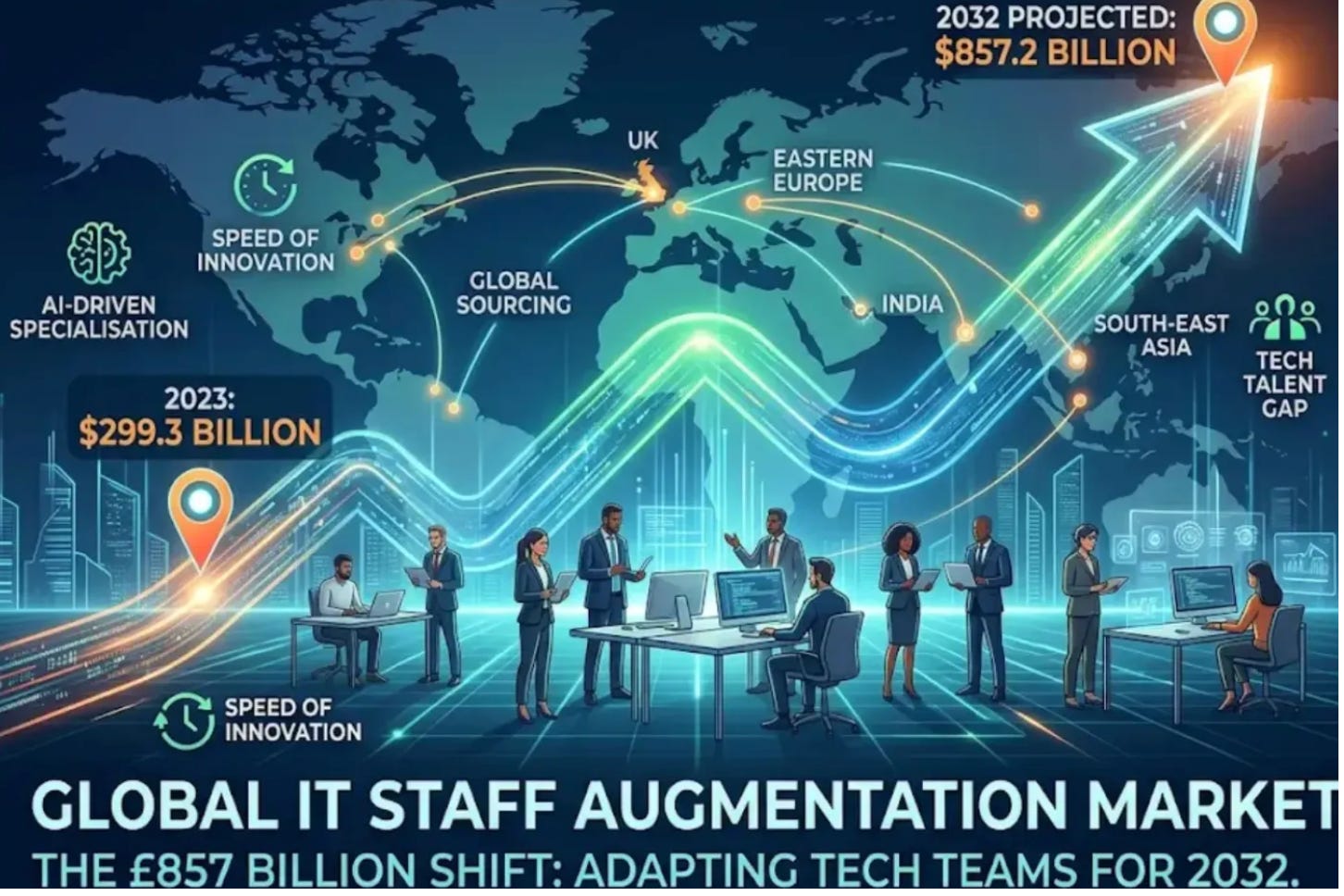
The global IT staff augmentation market is on track to hit $857 billion by 2032. That’s almost triple its size in 2023 and represents one of the most decisive shifts in how the world’s businesses build technology teams.
If you lead a UK tech operation, this isn’t market research trivia. It’s the explanation for why your hiring pipeline feels different, why your competitors seem to scale faster than you, and why “build versus buy” decisions for engineering talent have changed permanently. Tech recruitment market UK dynamics are being reshaped by global forces that show no sign of slowing.
The drivers are clear. ManpowerGroup found that 72% of employers report difficulty filling roles. Korn Ferry forecasts an 85.2 million-person global talent shortage by 2030. UK businesses face an 88-day average time-to-hire for specialist tech roles. None of this is going away.
In response, the IT staff augmentation market has matured from a niche outsourcing alternative into the default global solution for tech capacity. Here’s what the numbers mean, why the market is growing the way it is, and what UK tech leaders need to do about it.
What the Market Numbers Reveal
Let’s start with the headlines. Verified Market Research, one of the most-cited analysts in this space, valued the global IT staff augmentation market at $299.3 billion in 2023 and projects it will reach $857.2 billion by 2032. That’s a 13.2% compound annual growth rate.
Other analysts put the numbers slightly differently — Global Growth Insights estimates the IT staff augmentation and managed services market at $291.71 billion in 2025, rising to $707 billion by 2035 at a 9% CAGR. The exact figures vary by methodology, but every credible source agrees on the direction: this market is growing fast and reshaping enterprise IT.
What does this mean in practice? Roughly three-quarters of enterprises now use staff augmentation services to overcome talent shortages. IT staff augmentation UK adoption mirrors this global pattern. The flexible workforce model has moved from contingency plan to core operating decision.
The growth isn’t evenly distributed across regions. North America accounts for roughly 38% of the market in 2026. Europe holds another significant share. But the fastest growth is now in cross-border engagements — UK and US companies sourcing engineers from South-East Asia, Eastern Europe, and Latin America.
These are structural numbers, not pandemic-era spikes. Staff augmentation growth has continued every year since 2020 and shows no sign of plateauing.
The Forces Pushing the Market Higher
Three forces explain why this market keeps growing and why analysts keep raising forecasts.
The first is the growing tech talent gap. Korn Ferry projects an 85.2 million-person global talent shortage by 2030, with technology roles taking a disproportionate share. UK digital skills shortages alone could cost £27.6 billion by 2030 according to University of Birmingham research. The gap is too large to close with onshore hiring alone, which forces companies to look globally.
The second is the speed mismatch between hiring and innovation. The conventional recruitment model takes 88+ days for specialist roles. Modern product cycles run in 90-day quarters. By the time a domestic hire is productive, the project has already shifted twice. Staff augmentation collapses that gap from months to weeks, which is why CTOs increasingly default to it for new initiatives.
The third is the rise of AI-driven specialisation. Microsoft’s research shows 71% of business leaders now prefer a less-experienced AI-fluent candidate over a more experienced one without those skills. The supply of specialist tech talent in AI/ML, security, and modern data engineering is concentrated globally, not locally. Staff augmentation is how UK companies access it.
The combined effect is a tech talent market 2026 where flexible global sourcing isn’t just optional — it’s structurally necessary for any company serious about scaling.
How the Market Has Restructured Since 2023
The shape of the market has changed more in the last three years than in the previous ten.
Three trends stand out for tech outsourcing trends 2026.
First, the shift from time-and-materials to outcome-based contracts. The market has moved toward agreements that tie payment to delivery — feature completions, defect thresholds, performance SLAs — rather than hours billed. Outcome-based models align incentives between client and vendor and create clearer accountability.
Second, the rise of flexible workforce tech as standard infrastructure. Companies no longer maintain a “contingency” relationship with a staffing partner. They build dedicated team structures that work alongside their in-house engineers for years at a time. The line between “in-house” and “augmented” has blurred for most modern tech operations.
Third, the importance of compliance and data residency. With the EU AI Act fully effective from August 2026 and continuing GDPR scrutiny, the tech recruitment trends show that vendor compliance posture now carries as much weight as technical capability in selection decisions. UK companies serving European customers can’t separate talent strategy from regulatory strategy any more.
The market has also seen consolidation among providers. The biggest beneficiaries are specialist partners who combine deep regional sourcing with strong UK business understanding — not the giant generalist outsourcers of the past.
Where the Best Talent Now Comes From
The geography of the global software developer market has shifted significantly.
Eastern Europe (Poland, Ukraine, Romania) remains a strong source of senior engineering talent at $35–55 per hour for mid-level developers. Time zone overlap with the UK is excellent. English proficiency is high. Engineering depth is consistently strong.
South-East Asia is the fastest-growing region for cost-effective senior talent. Vietnam now has 650,000+ IT professionals and produces 57,000 tech graduates annually, with rates of $25–35/hour for mid-level and $35–50/hour for senior engineers. The Philippines offers similar rates with very strong English proficiency. Indonesia is emerging fast.
India remains the largest single source of IT talent globally, with over 1.5 million IT graduates annually and an established outsourcing infrastructure. Rates range from $20–50/hour depending on seniority and specialisation.
For SE Asia software market engagement, time zone overlap with the UK is a genuine advantage. SE Asian working hours give 3–4 hours of productive overlap with UK afternoons, which suits async-first management models.
Latin America has emerged as a strong nearshore option for North American companies but is less commonly used by UK businesses given the larger time zone gap.
The right answer depends on your priorities. If cost dominates, Asia leads. If cultural and time zone proximity matter most, Eastern Europe wins. If you need scale and depth across all specialisms, India remains hard to beat.
What This Means for UK Tech Leaders
The implications for UK CTO talent strategy are clear and significant.
First, treat global sourcing as a primary capability, not a fallback. The market data shows 74% of enterprises now operate this way. Companies still defaulting to UK-only hiring are operating against the trend.
Second, choose partners deliberately. UK tech hiring market maturity now lets you select specialist staff augmentation partners with deep regional knowledge, strong vetting processes, and transparent compliance. Don’t settle for generalists.
Third, plan for years, not quarters. The most successful UK operators don’t engage offshore talent project by project. They build dedicated team relationships that last 3–5+ years. The retention, knowledge depth, and quality compound dramatically over time.
Fourth, invest in your in-house leadership layer. Global teams need strong UK-side leadership to set direction, make architectural decisions, and represent the business to customers. The most effective model is a senior UK leadership team plus a larger augmented delivery team in your chosen region.
The market is at an inflexion point. Growth from $299 billion to $857 billion in less than a decade represents a structural change in how technology gets built. Leaders who adapt now have a significant window of advantage.
The £857 billion projection for the IT staff augmentation market by 2032 isn’t a forecast based on optimism. It’s the inevitable consequence of a structural mismatch between technology demand and domestic talent supply that no amount of UK-only hiring can close.
For UK tech leaders, the question isn’t whether to engage with this market. The market data shows that’s already settled — three out of four enterprises use staff augmentation today. The real question is how well you engage. The companies winning are those building deep, multi-year partnerships with specialist regional providers who understand UK business standards and compliance requirements.
If you’re still treating tech talent as a domestic problem to be solved with domestic hires, you’re operating with a 2018 playbook in a 2026 market. The talent intelligence is clear, the partner ecosystem is mature, and the productivity gains are real.
Ready to scale your tech team? Get in touch with ThoughtGears — we’d love to hear about your project.
FAQs
How big is the global IT staff augmentation market?
Verified Market Research projects the market will reach $857.2 billion by 2032, up from $299.3 billion in 2023.
Why is this market growing so fast?
Three main drivers: a structural global tech talent shortage projected to reach 85 million people by 2030, the speed mismatch between traditional hiring and modern product cycles, and the rise of AI-driven specialisations.
What’s the difference between IT staff augmentation and outsourcing?
Outsourcing typically involves handing over an entire function or project to a vendor. Staff augmentation brings external engineers into your team to work alongside your in-house staff under your direction.
Which regions offer the best IT staff augmentation talent?
South-East Asia offers the best cost-quality balance with good UK time zone overlap. Eastern Europe provides senior engineering depth. India offers the largest scale.
What’s the typical hourly rate for offshore developers?
Mid-level developers in Southeast Asia typically range from $25–35/hour. Eastern European developers range from $35–55/hour. UK equivalents typically range from £75–120/hour.
How does the EU AI Act affect IT staff augmentation in 2026?
With the AI Act fully effective from August 2026, vendor compliance posture is now a critical factor in selection.
Is staff augmentation suitable for small UK businesses?
Yes. The market has matured significantly. Starting with 1–2 augmented engineers on a defined initial project is a sensible entry point.
What’s the difference between dedicated teams and project-based augmentation?
Dedicated teams work exclusively on your business over months or years. Project-based augmentation brings engineers in for specific deliverables.
How do I avoid the common mistakes UK companies make with staff augmentation?
Don’t choose on price alone, invest properly in onboarding, design async-first management practices, and choose specialist providers over generalists.
Will AI tools eventually replace staff augmentation?
No — they’re amplifying it. AI tools make individual developers more productive, but don’t reduce the need for skilled engineers.
⚠️ Disclaimer
Market size figures are estimates from third-party research firms and vary by methodology. ThoughtGears is not a financial, investment, or legal adviser. Always verify market data with primary sources and consult qualified professionals before making strategic talent investments based on market projections.