
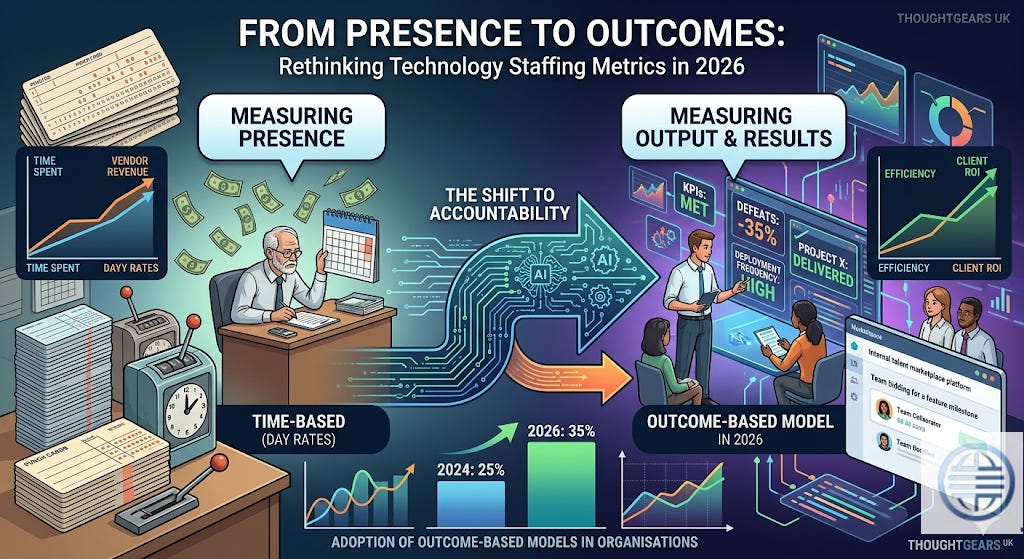
Day rates have been the default unit of measurement in technology staffing for decades. They are familiar, easy to compare, and simple to contract around. They also measure the wrong thing.
A day rate tells you how much someone costs per day. It tells you nothing about what they will deliver. Two engineers on identical day rates can produce radically different outcomes — in code quality, delivery speed, architecture decisions, and long-term maintainability. Yet the billing mechanism treats them as equivalent.
This disconnect is at the root of a structural shift happening in technology staffing in 2026. Organisations are moving — deliberately, and in increasing numbers — toward models that tie compensation and accountability to outcomes rather than presence.
The Problem With Time-Based Billing
Time-based billing creates a fundamental misalignment of incentives. When a vendor is paid by the hour or the day, their revenue increases with the time taken. There is no financial incentive to deliver efficiently, identify shortcuts, or reduce scope.
What has changed in 2026 is the practical ability to do something about it. Better tooling for tracking delivery, more sophisticated vendor management practices, and a shift in the balance of power in the buyer-supplier relationship have all contributed to making outcome-based models viable at scale.
What Outcome-Based Staffing Actually Means
Feature delivery milestones. Payment or performance evaluation is linked to defined functionality being delivered to a defined standard.
KPI-linked compensation. Individual or team compensation structures incorporate targets tied to business metrics — deployment frequency, defect rates, system availability, or product performance measures.
Internal talent marketplaces. Organisations are building internal platforms where teams bid for work and are evaluated on delivery outcomes. Thirty-five per cent of organisations now operate these, up from 25 per cent in 2024.
What all of these models share is accountability for results rather than accountability for attendance.
The Data Behind Adoption
The jump from 25 per cent to 35 per cent of organisations using outcome-based internal talent structures in a single year suggests this is past the early adopter phase and entering mainstream practice.
Client organisations are increasingly insisting on SLA structures tied to business outcomes rather than service consumption. Managed service providers who cannot offer outcome-based commercial models are finding themselves at a competitive disadvantage in procurement conversations.
The underlying driver is accountability. Boards and executive teams are increasingly asking technology leaders to demonstrate return on IT spend in business terms. The day rate is difficult to defend in that language.
How AI Is Enabling the Shift
AI-powered tracking systems have made it easier to define, monitor, and attribute outcomes at the team and individual level. Platforms now exist that can track delivery metrics across codebases — commit frequency, pull request cycle times, defect introduction rates — and correlate these with business outcomes.
Without the measurement infrastructure, outcome-based models default to milestones that are too coarse to be useful. AI-enabled delivery analytics make the model more precise and more actionable.
What It Means for Buyers and Suppliers
For organisations buying technical talent, outcome-based models require more investment in upfront definition — what does “done” look like? What business metric are we trying to move? But the return on that investment is accountability.
For suppliers of technical talent, outcome-based models introduce risk. The suppliers embracing rather than resisting this shift are those with genuine confidence in their delivery capability. For them, outcome-based models are an opportunity to differentiate in a market where most competitors compete on rate alone.
Day rates will not disappear overnight. But the trend line is clear. As measurement tools improve, as buyer sophistication increases, and as the pressure to demonstrate ROI on technology investment intensifies, time-based billing will continue to cede ground to models that answer the question that actually matters: what did we get?
FAQs
Q: What is outcome-based staffing?
A model in which compensation and accountability are tied to defined deliverables — features shipped, KPIs met, milestones reached — rather than time spent. It replaces day rates as the primary unit of measurement in technology staffing arrangements.
Q: How widespread is outcome-based staffing in 2026?
35% of organisations now use outcome-linked internal talent structures, up from 25% in 2024. Adoption is spreading from large technology companies into managed services and enterprise IT procurement.
Q: What is the problem with day rates?
They create a misalignment of incentives: the vendor’s revenue increases with time taken, so there is no financial motivation to deliver efficiently. Day rates measure presence, not output.
Q: What does an outcome-based contract look like in practice?
It typically includes defined deliverables with quality standards, KPI-linked performance evaluation, and clear criteria for what constitutes successful delivery tied to business outcomes rather than hours logged.
Q: How does AI support the shift to outcome-based models?
AI-powered delivery analytics platforms can track code quality metrics, deployment frequency, and defect rates — giving leaders the measurement infrastructure to define outcome-based contracts with confidence.
Q: Does outcome-based staffing work for all types of technology work?
Best for work where outputs are well-defined and measurable — feature delivery, migration projects, security improvements with defined criteria. Less suited to highly exploratory or ambiguous work.
Q: What does this mean for technology contractors and vendors?
It introduces accountability risk for those whose delivery confidence is low — and a competitive opportunity for those whose isn’t. Suppliers who can offer outcome-based models credibly are differentiating themselves in a rate-competitive market.
Q: Why are boards pushing for outcome-based IT spend?
Because day rates are difficult to justify in business value terms. A milestone tied to a measurable business outcome is far easier to defend in executive and board conversations about ROI.
Q: What is an internal talent marketplace?
A platform within an organisation that allows teams to bid for work based on capability and availability, with performance evaluated against delivery outcomes. 35% of organisations now operate these.
Q: How do you transition from a day-rate model to an outcome-based one?
Start with a well-defined project where the success criteria are clear. Invest in scoping and upfront definition. Put measurement infrastructure in place. Evaluate the first engagement thoroughly before scaling.